The current estrogen patch shortage has nothing to do with sweet potatoes, yams or soybeans….
But a lot to do with - manufacturing, gender and, for Australia, our (brilliant) PBS


If you’ve been trying to fill a script for an estrogen only patch lately, you already know something is wrong. Pharmacists are scrambling. Doctors are improvising. Women are driving around cities and towns. The TGA has had an active shortage notice running since 2023 — and they’ve just extended it to February 2027.[1]
ABC News did a great article last week on the Menopause HRT patch shortage in Australia but contained within it was a statement I have seen numerous times, and I think it’s important to clarify.
“the first issue along the supply chain was at the start, with soya beans and sweet potatoes — the raw ingredients used in most patches — in high demand and short supply globally.”
Right now, this isn’t actually correct…
& it isn’t a supply hiccup. It’s the predictable result of decades of underinvestment in women’s health, quietly coming to a head all at once.
Let me explain what’s happening, and why it’s probably going to get worse - unfortunately - before it gets better.
PART ONE: MANUFACTURING
The Australian estrogen only patch market relies on two facilities. Both are struggling.
Australia (and New Zealand) have no domestic manufacturing capability for estradiol patches. Zero. Every patch dispensed in this country is imported, and right now, that import chain appears to run through just two facilities.
The first is Noven’s plant in Miami, which manufactures for Sandoz globally (that’s your Estradot) as well as its own brands. The US Department of Health and Human Services has publicly confirmed that all five US estradiol patch manufacturers are operating at full capacity.[2]
Noven says it’s fulfilling all orders, but then adds, carefully, that “supply challenges are possible” as demand rises.[3]
Sandoz, entirely dependent on Noven, has acknowledged that “unprecedented demand cannot be fully met at present.”[3]
Multiple patches are formally listed in shortage by the American Society of Health-System Pharmacists.[4]
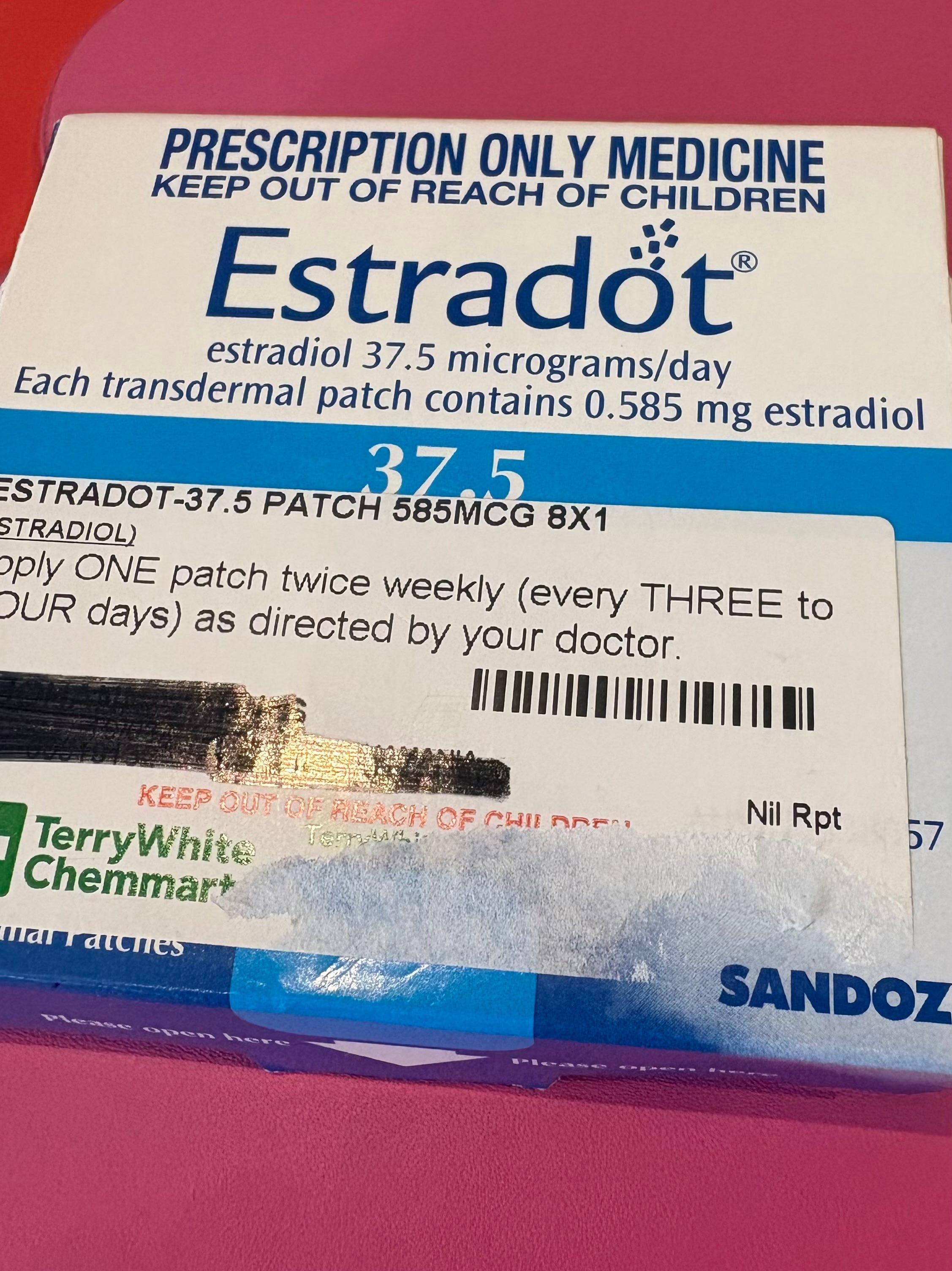
The second is LTS Lohmann’s facility in Germany, which makes patches for the Estraderm MX brands sold in Australia through a multi-party Novartis → Norgine → Juno Pharmaceuticals licensing chain.
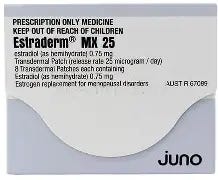
That’s it. Two facilities. Under pressure.
No domestic backup.
No third option.
If you want to read a great background piece that provides more context on the complexity of the manufacturing (note its US centric) then I highly recommend Dr. Amy B. Killen MD Substack Is It Patch-Worthy?

How did we get here?
Until late 2023, the global supply picture was slightly more resilient. There were 3 supply pathways: the Noven/Sandoz network, Bayer’s Climara® (Australia) and Progynova® TS (UK) (both manufactured by Kindeva in California), and Juno’s Estraderm MX from LTS Lohmann in Germany.
Then Bayer made a commercial decision.
In late 2023, they discontinued Climara® globally. Then, in February 2026, they discontinued Progynova® TS in the UK. Two estradiol-only patch products, gone within 26 months — not because the manufacturing capability disappeared, but because Bayer decided these products no longer fit their commercial priorities.
Why, you might ask, well, that’s a future Substack….
The Kindeva facility in California is still operational. The machines still work. Bayer just chose not to use them to manufacture estrogen only patches anymore.[5]
That decision, entirely rational from a portfolio management perspective, removed significant global supply right as demand was beginning to surge. And then demand really surged.
The FDA removed the black box warning. Everything changed.
In November 2025, the FDA removed the black box warning from bioidentical estradiol patches.
For anyone not an expert in regulatory history: the black box warning had been applied to all hormone therapy products in the US since the 2002 Women’s Health Initiative study, a study that has since been substantially reanalysed and whose conclusions about estradiol patches were always questionable. The warning shaped two decades of prescribing behaviour, contributing to dramatic under-treatment of menopause symptoms in millions of women.
Its removal was a signal to clinicians, patients, and the media: this is safe. Prescriptions accelerated. Demand surged further.
And manufacturers, already at capacity, had very little ability to respond.
This exposed, for anyone looking closely, the capacity constraints in the system.
This isn’t a short-term issue
Here’s the thing that makes this genuinely serious for Australian women over the next several years: there is no announced solution.
Noven’s only confirmed expansion is a quality control laboratory building, which they broke ground on in April 2024.[7] That’s a QC lab. It enables faster batch release. It doesn’t add manufacturing lines. So, no ability to scale up production of more actual patches.
Building a new pharmaceutical manufacturing facility, from decision to commercial output, is time consuming and expensive, and can take three to five years, assuming everything goes right with regulatory approval, validation, and scale-up.
There are no disclosed plans for any new large-scale facilities for estradiol patch manufacturing globally that I could find. If you know of one, please reach out. I am trying to map the entire global MHT patch manufacturing ecosystem.
An example of another MHT product that recently experienced huge supply issues was Estrogel. The only way Besins Healthcare, owner and manufacturer of Estrogel, addressed the massive supply shortages that plagued its product in Europe and the UK in 2021 and 2022, was through building a substantial new manufacturing facility in Muel, Spain. Ramping up production at all its existing facilities did not solve the shortage. Only a new facility did.
The market structure that created this shortage is, at some point, going to require significant investment.
So what could that look like?
For us, it looks like Australia taking back what offshoring quietly stole from us.
Our sovereign capability.
There is a version of this story where the estrogen patch shortage is just another item on the TGA’s shortage register. Managed. Apologised for. Occasionally improved by the offshore manufacturers when it suits their commercial priorities (but given all three registered patches in Australia are on the PBS, this is increasingly unlikely…).
Women wait. Pharmacists shrug. Extension notices keep coming until 2027, then 2028, then some date beyond that. We accept that the medicines Australian women depend on are made somewhere else, by someone else, for someone else’s market, and we receive what is left-over.
That version, well we - Australian midlife woman - have already been living it for the past 5yrs. & we are fed up and furious.
But there could be another version.
This the one I want to see come to fruition.
Australia has spent the better part of three decades quietly dismantling its domestic pharmaceutical manufacturing capability. We offshored it, as so many countries did, chasing the logic of cheaper global supply chains and comparative advantage. For a long time, it worked….until it didn’t. COVID-19 exposed the weakness and vulnerabilities we as a country had left ourselves vulnerable to.
The estrogen patch shortage is the same lesson, playing out more slowly, with less political urgency (because women’s health 🙄), for the medicines that half the population need as they age.
This is not a niche problem. Menopause affects every woman who lives long enough.
The Oceania region is currently almost entirely dependent on two facilities in Miami and Germany, both of which are already at capacity, neither of which was designed with this region in mind. When those facilities have a bad year, or a key supplier fails, or most likely, a pharma giant decides the margin isn’t worth it anymore, women across our entire region simply go without.
That is not an acceptable foundation for healthcare in the 21st century.
Australia has a once-in-a-generation opportunity to do something different. To look at a global manufacturing crisis and respond not with a shortage notice, but with sovereign capability. To build a regional anchor, a vertically integrated, next-generation facility designed from the ground up to serve Australia, New Zealand, the Asia-Pacific and possibly even the world. And in doing so, demonstrate that this country can rebuild its pharmaceutical manufacturing base by solving real problems for real patients, not by chasing the same global commodity race that left us exposed in the first place.
This is how nations build lasting health security. Not by managing shortages better, but by eliminating the conditions that create them.
We have the regulatory framework. We have the scientific capability. We have a patient population that is furious, a clinical community that is frustrated, and a market need that is only going to grow as awareness of menopause treatment catches up with decades of medical underinvestment in women’s health.
The choice isn’t between a local solution and a global problem. The local solution is the answer to the global problem. Australia can manufacture its way out of this shortage and become the global supplier of choice for a market that currently has nowhere else to turn.
This is not a niche biotech play. It’s nation-building.
So what we need is the ambition to match the moment.
We - Lorai Health - have it.

Does our government?
This piece was co-authored by Johanna Wicks & Raisa Monteiro who are the co-founders of LORAI Health. LORAI Health is an Australian pharmaceutical company that is re-imagining menopause hormone therapy patches for the ANZ and Asia-Pacific market, before scaling globally.
Disclaimer:
This analysis is based on publicly available information and industry sources. Manufacturing structures and supply arrangements may not be fully disclosed and may evolve over time. Please reach out if you know anything to help us continue building our map of MHT patch global manufacturing.
Want to support Lorai Health?
You can sign up for sign up for our Newsletter, follow our Instagram and LinkedIn and read Kate Muir’s Substack from February.
PART TWO: What does gender have to do with it?
PART THREE: Why is Australia at the bottom of the supply chain?
References
[1] TGA. About the shortage of transdermal HRT patches. Updated 20 March 2026. Australia’s Department of Health has extended the Serious Scarcity Substitution Instrument to 28 February 2027. Also: Pharmac (NZ) shortage declaration: Australasian Menopause Society, menopause.org.au/mht-shortages/.
[2] The Hill. Estrogen patch demand rises amid supply issues. February 2026. HHS spokesperson confirmed all five estradiol patch manufacturers are operating at full capacity.
[3] CNN. Estrogen patches in short supply as demand for menopause hormone therapy grows. 23 February 2026. Noven and Sandoz statements on supply capacity.
[4] ASHP Drug Shortage Database — Estradiol Transdermal System. Created 30 January 2026, updated 19 February 2026. Sandoz provided no reason for the shortage. ashp.org/drug-shortages.
[5] Climara discontinuation timeline: Global discontinuation announced late 2023, with remaining inventory depleted by early 2024. Bayer cited ‘strategic portfolio optimization’ and ‘focus on growth markets’ as reasons. No manufacturing constraints cited - Kindeva facility continued operations for Climara Pro combination product. See: Climara Pro Shortage Update (MedFinder, 2026)
Progynova TS UK discontinuation: Community Pharmacy England notification confirmed discontinuation of 50mcg strength from ‘late December 2025’ and 100mcg strength from ‘February 2026.’ Products manufactured by the same Kindeva Drug Delivery facility as discontinued Climara. The patient information leaflet confirms ‘Bayer plc’ as marketing authorization holder with manufacturing by ‘3M Drug Delivery Systems, Northridge, CA’ (now Kindeva). See: Medicine Supply Notification: Progynova TS (Community Pharmacy England)
No manufacturing constraints were cited by Bayer in connection with either discontinuation. The Kindeva Drug Delivery facility (formerly 3M Drug Delivery Systems) in Northridge, CA continues full commercial operations, manufacturing patches for multiple pharmaceutical clients including Bayer’s own Climara Pro combination product. The continued deployment of the same facility for a higher-value Bayer product ($250-365 per month USD) supports the inference that the estradiol-only exits were driven by commercial portfolio decisions rather than operational or manufacturing limitations
[6] Theramex 4-party supply chain structure identified via patient information leaflets: LTS Lohmann Therapie-Systeme AG (primary patch manufacturing, Andernach Germany) → Aesica Pharmaceuticals GmbH / Recipharm AB (secondary packaging, Monheim Germany) → PharmaPac UK Limited (blister packing, Bidston Wirral) → Theramex HQ UK Limited (commercial/marketing only, London). Theramex’s public statements of ‘multiple manufacturing partners’ mask reality of single patch manufacturer plus multiple packaging contractors.
[7] Noven’s groundbreaking announcement and Miami-Dade County incentive approval: Miami Today, March 2024. Miami-Dade approved $709,420 Target Jobs Incentive Fund grant for 24,500 sq ft QC lab expansion at cost of $39.3M. Note: QC lab expansion enables batch release throughput improvements but does not add manufacturing lines or resolve the production capacity ceiling. IQVIA MIDAS 2024 data cited for global MHT patch market growth figures (14% growth in 2024; patch sales 30% of total estradiol market).
What a brilliant and insightful article!! I had no idea, it’s so easy to believe what the media tells us. Sadly. We should all be supporting an Australian solution, and LORAI Health is that solution! Bravo. 👏